
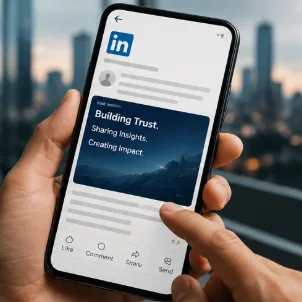
Ask most SME owners about LinkedIn and you will get the same reaction: "isn't that for people looking for a new job?" It used to feel that way. These days, it is one of the few platforms left where a genuine post from a business owner — no ad spend, no filters, no dance trends — can reach exactly the people who make buying decisions: other business owners, procurement managers, HR leads and B2B customers.
The problem is not whether LinkedIn works for SMEs. It clearly does. The problem is that most business accounts either go silent after two posts, or post nothing but recycled motivational quotes that nobody remembers. This guide sets out what is actually worth posting, in what order, and how to keep it going without it becoming another full-time job.
Why LinkedIn matters even if you sell to consumers, not corporates
LinkedIn is usually filed under "B2B only," but that undersells it. Even consumer-facing SMEs — a bakery, a renovation firm, a fitness studio — benefit from a presence there, because the people reading LinkedIn are also your landlords, your suppliers, your bank relationship managers, potential hires and, quietly, potential customers who happen to be scrolling during lunch.
The bigger reason it matters: LinkedIn currently rewards personal profiles and genuine business updates with far more organic reach than Facebook or Instagram give an unpaid business page. A well-written post from the founder can be seen by thousands of people for free. That is increasingly rare.
The shift to notice
LinkedIn is no longer a static CV site. It behaves like a content platform now — the algorithm favours posts that get comments and shares in the first hour, exactly like Instagram or TikTok.
Should it be the company page or the founder's personal profile?
This is the single most common question we get, and the answer is almost always: the founder or a named team member, not the faceless company page. People connect with people. A company page post gets a fraction of the reach of the same content posted from a personal profile, because LinkedIn's algorithm is built around personal networks.
- Use the company page for official announcements, hiring, and reposting from your team.
- Use the founder's or a team member's personal profile for the bulk of your content — stories, opinions, behind-the-scenes.
- If you have more than one person comfortable posting, spread the load. Two voices posting once a week beats one person posting daily and burning out.
The five content pillars worth building around
Rather than staring at a blank post box each week, work from a short list of repeatable themes. Rotate through them and you never run out of ideas.
1. What you actually do (in plain language)
Most SME owners assume everyone already understands their business. They do not. A short post explaining a service, a process, or a common misunderstanding in your industry consistently performs well because it is genuinely useful.
2. Lessons from running the business
Posts about a mistake you made, a decision you reversed, or something that surprised you tend to outperform polished announcements. People trust specifics far more than slogans.
3. Proof of work
A finished project, a client result, a before-and-after, a milestone. Numbers help: "we cut delivery times from 5 days to 2" travels further than "we are proud to announce our commitment to excellence."
4. People and culture
A photo of the team, a new hire, a small win, how you celebrated a birthday in the office. This humanises the business and is usually the easiest content to produce.
5. Opinions on your industry
A short, respectfully stated view on a trend, a regulation, or a common practice you disagree with. This is the riskiest pillar but often the one that generates the most comments — and comments are what LinkedIn rewards most.
What tends to fall flat
- Generic motivational quotes with a stock sunrise image — widely ignored, and slightly harm your credibility.
- Pure sales posts with no story, context or proof attached.
- Reposted press releases copied word for word from your own website.
- Anything written entirely by AI with no editing — readers can tell, and it reads as impersonal on a platform built around personal voice.
- Posting once, then disappearing for three months. Consistency matters more than frequency on LinkedIn.
If a post would look identical coming from any other company in your industry, it is probably not worth posting. Specificity is what makes people stop scrolling.
How to format a post so people actually read it
LinkedIn posts get cut off after the first few lines with a "see more" prompt. Your first two lines have to earn the click, the same way a headline earns a scroll.
A structure that works
- Line 1–2: a hook — a question, a surprising fact, or a bold statement.
- Body: short paragraphs, one idea each, plenty of line breaks.
- A concrete example or number wherever possible.
- A soft close: a question inviting comments, not a hard sales pitch.
- One relevant image, or a short native video — both outperform text-only posts and outperform external links, which LinkedIn tends to suppress.
Practical example: an interior design studio in Singapore posted "We turned down this client's brief. Here's why." as an opening line, followed by a short story about mismatched expectations on budget. It generated more comments than any product showcase they had posted in the previous six months, because it was honest and specific rather than promotional.
How often should an SME actually post?
Two to three times a week from a personal profile is enough to build momentum without turning into a chore. Daily posting is not necessary and often leads to weaker, rushed content that damages the account's credibility rather than building it.
| Frequency | Realistic for |
|---|---|
| 1x per week | Busy owner, testing the waters |
| 2–3x per week | Sustainable sweet spot for most SMEs |
| Daily | Rarely sustainable without a content team; quality usually drops |
Batch content on a quiet day. Write three or four posts in one sitting on a Monday morning, schedule them, and you have covered the week without opening LinkedIn again until it is time to reply to comments.
Engagement matters as much as posting
LinkedIn's algorithm pays close attention to what happens in the first 60 minutes after you post — comments especially, more than likes. Reply to every comment quickly, and spend ten minutes before or after posting commenting genuinely on other people's posts in your industry. This does more for your reach than most people expect, and it costs nothing.
- 1Post when your audience is likely online — usually weekday mornings in Singapore.
- 2Reply to comments within the first hour if you can.
- 3Comment thoughtfully on five other posts a week, not just your own.
- 4Tag people or companies only when it is genuinely relevant, never to bait attention.
A simple weekly plan you can actually stick to
| Day | Post type |
|---|---|
| Monday | A useful tip or common misunderstanding in your industry |
| Wednesday | Proof of work — a project, result or client story |
| Friday | People and culture, or a personal reflection on the week |
This is not a rigid formula, but it removes the blank-page problem. Once posting becomes a habit rather than a decision, it stops feeling like extra work.
Frequently asked questions
Should my business have both a company page and personal profiles active?
Do I need professional photos for LinkedIn posts?
Is LinkedIn worth it for a business that only sells locally in Singapore?
How long before LinkedIn posting brings in actual leads?
Can AI help write LinkedIn posts?
Want a content plan that actually gets posted?
We help Singapore SMEs build simple, sustainable content systems across LinkedIn and other channels — strategy, drafts and a rhythm you can keep up with.
Talk to Us About Content